
Sweet shops
The rate changed this morning. So did every board.
Per-kilo rates, fresh-today trays, gift box ranges and the order counter — on the screens above the display case, changed from one phone.
A sweet shop is priced by the kilo and the kilo price does not sit still. Milk goes up, dry fruit goes up before every festival, and the rate on the card taped to the glass is the rate from whenever somebody last had a marker pen in their hand. Twenty varieties means twenty cards.
Then there is the season, which is most of the year’s money. Eid, Shab-e-Barat and the wedding months bring gift ranges that exist for three weeks and then should disappear. A banner for a range you have run out of is worse than no banner.
And the counter itself. On the three days before Eid the shop is full, the orders are by weight, and every customer is asking whether theirs is ready. A number on a screen answers that without anybody shouting over the crowd.
What usually goes wrong
The starting point
- Twenty varieties priced on twenty handwritten cards, and the rate moved this morning
- Eid and wedding ranges advertised on a banner that outlives the season
- Three days before a festival the counter is a crowd and nobody knows whose box is ready
One rate change, every board
Change the per-kilo price in the panel and the screens over the case agree within seconds. No cards, no marker.
Seasonal ranges with an end date
The Eid box goes up on a date and comes down on a date you set when you build it, so it never outlives the stock.
The order counter, called
A token number on its own screen, announced out loud, so the crowd before a festival sorts itself out.
In practice
What goes on the screens
Six things this trade puts up, rather than six things a signage brochure says you could.
Today’s rate, per kilo
Barfi, laddu, gulab jamun and the rest, at this morning’s figure.
Fresh today
What came out of the kitchen in the last hour.
Gift box ranges
Half kilo, one kilo and the premium tray, priced.
Eid and wedding specials
A range that starts and stops on the dates you set.
Order counter token
The number being served, shown and announced.
Bulk and wedding orders
What you take, the notice you need, and the number to ring.
On the wall
What this looks like in a sweet shop
Two of the boards this trade runs. Both are built from a template in the panel, so the third one looks like the first and a price changed in one place is changed everywhere.
Placement
Where the screens go
The question every first conversation reaches within ten minutes. In the order most places buy them — and the first one is usually enough to start.
- 01Above the display case, carrying the rates
- 02In the window, for the people walking past
- 03At the order counter, for the token being called
- 04By the door as a totem, for the festival range
The moment that matters
One alert, every screen, in seconds
Everything else on this page is the ordinary day. This is the reason people actually buy it.
Take it with you
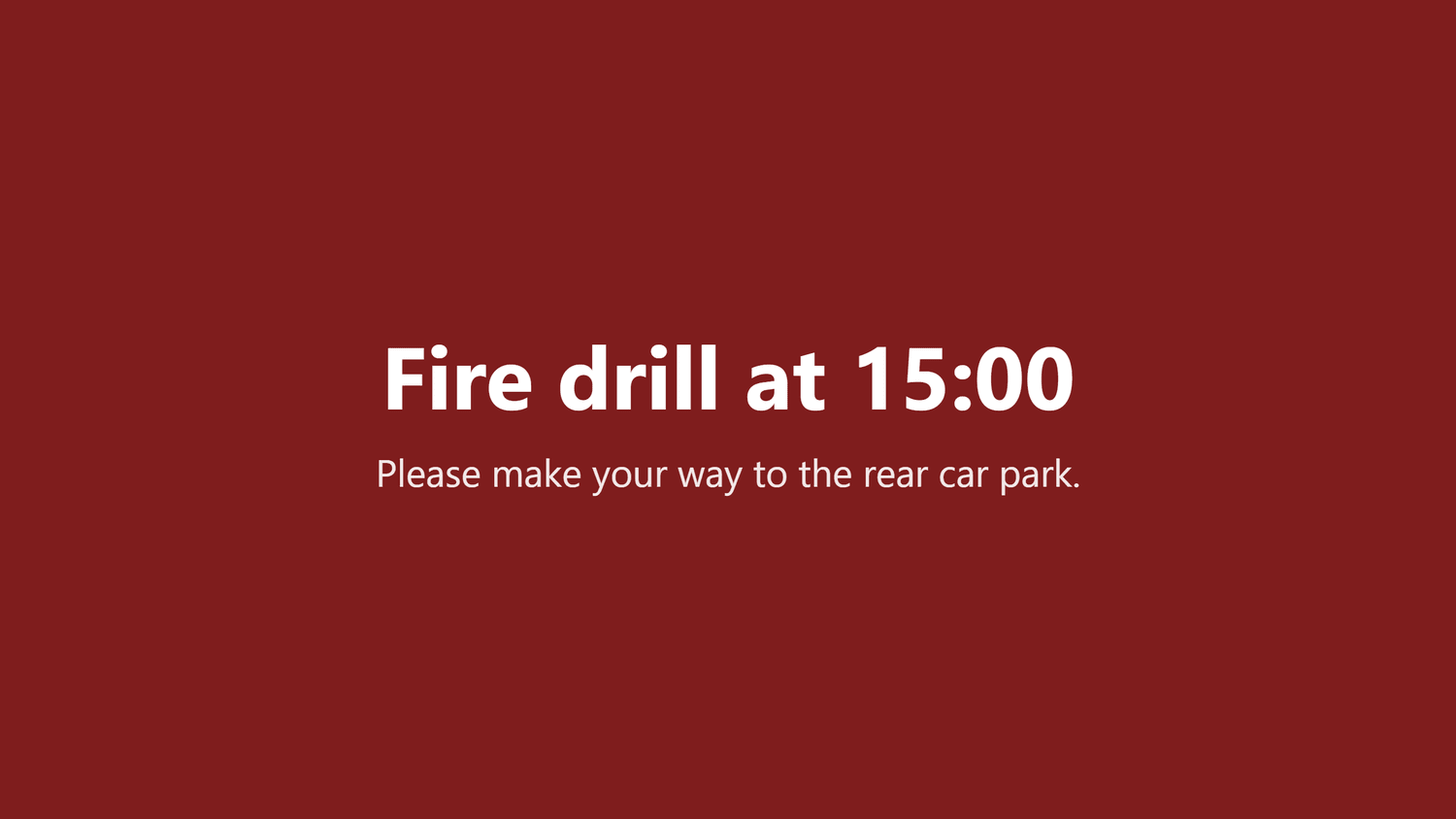
A guide for sweet shops
17 pages: who builds it, what it does in this trade, mock-ups of the boards and of the panel itself, every feature rather than a highlights reel, what it runs on, and what it costs — priced in your own currency, with every band on one page. Written for the person who has to say yes.
PDF · 17 pages · A4
Before you ask
Questions from this trade
- How quickly can I change a per-kilo rate?
- From your phone, in seconds. Type the new figure in the panel and every screen over the case has it within a few seconds — including the one in the second branch.
- Can I run a different range at each branch?
- Yes. Branches are groups, so the head shop can push a festival range to all of them at once while each keeps its own rates and its own fresh-today list.
- Can the order counter call numbers out loud?
- Yes. The token appears on the screen and is announced as speech, which is what the three days before Eid actually need.
- How many screens does a sweet shop need?
- Usually two or three over the display case and one at the order counter. That is comfortably inside the smallest band, and the televisions are often already there.
- What happens if the internet drops during a rush?
- Nothing visible. Every screen plays from its own storage, so the boards stay up through the outage and catch up with whatever changed the moment the line is back.
Other settings
Where else this is used
Restaurants & cafés
Digital menu boards that change in seconds
Retail stores
Offers and pricing across every branch from one panel
Hotels & guest houses
Lobby, lifts, conference boards and wayfinding
Offices
Reception, meeting rooms, company news, fire drills
Factories & warehouses
Safety notices and shift boards that survive the network
Hospitals & clinics
Waiting rooms, wayfinding, and a channel that outranks everything
Schools & universities
Campus notices, timetables and lockdown messaging
Government & public sector
Separated, auditable, and answerable to a named person
Gyms & fitness studios
Class timetables, inductions and the screens by the weights
Salons & spas
Price lists, treatment menus and the wait at the chair
Pharmacies
Counter queues, health advice and the shelf behind you
Banks & finance
Branch queues, rates and compliance notices
Car showrooms
Stock on the floor, finance examples and the handover wall
Estate agents
A window of listings that changes itself
Supermarkets
Aisle ends, fresh counters and the queue at the till
Mosques & places of worship
Prayer times, announcements and appeals
See it running on your own screens
We will set up a live system with your own login, and walk you through anything you want to see.
No open demo, no sign-up wall, a person reads every request.