
Getting started
From nothing to a screen on the wall
Two minutes per screen, and no account, licence key or vendor cloud anywhere in the process.
- 1
Install a player
One APK on an Android television, or a URL in any browser. Nothing to configure on the device itself.
The Android player is a single 2.6 MB file. The web player is a URL. Neither needs an account, a licence key, or anything typed into the device beyond the address of your own server.
- 2
Pair it from the panel
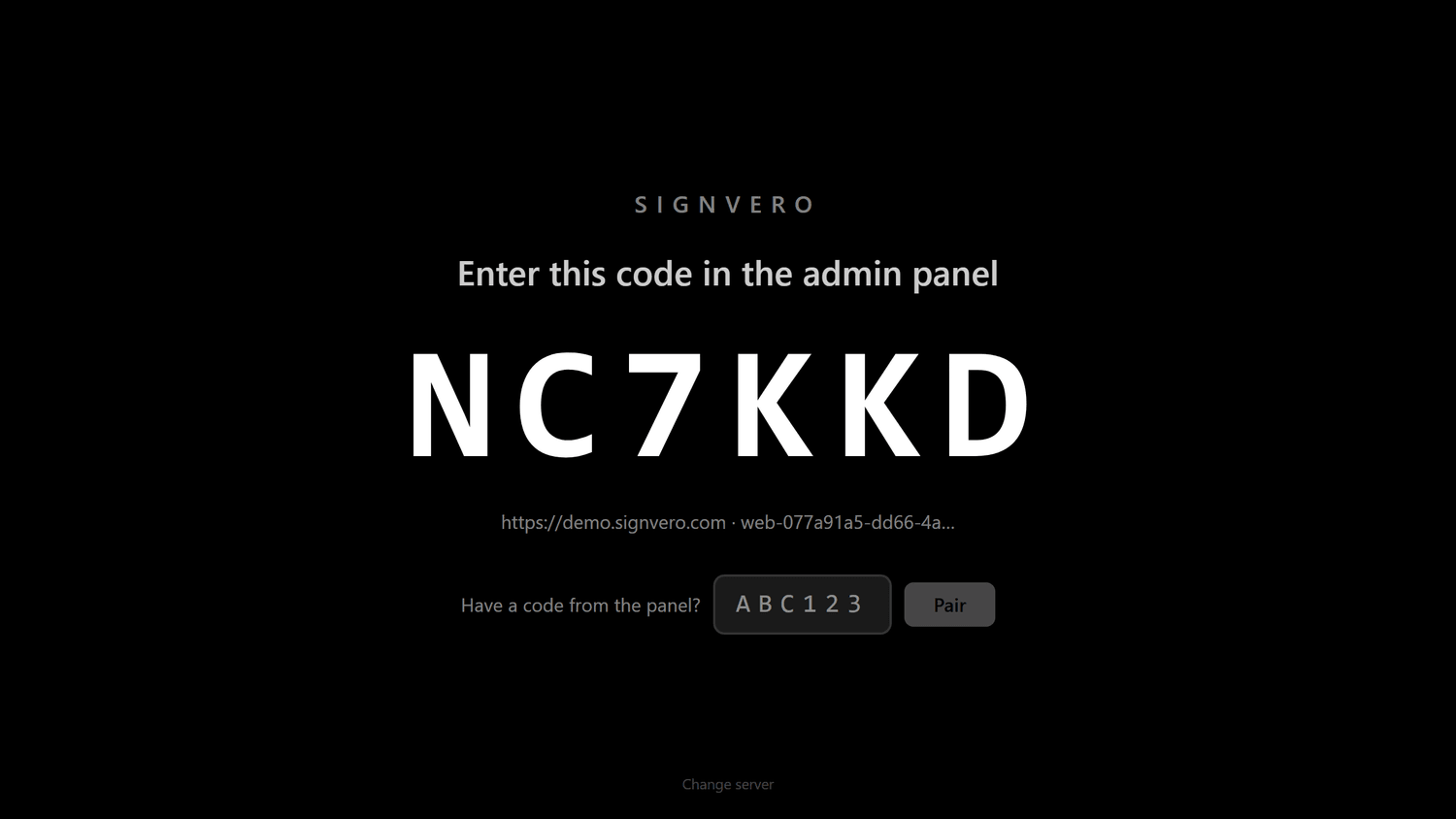
The screen shows a six-character code. Type it into the panel, name the screen, and it starts playing.
Pairing works in both directions: the screen can show a code for someone at a desk to claim, or the panel can print a code for an installer to type into the set. Both end at the same place.
- 3
Build a playlist
Upload images and video, or use one of five announcement layouts. Set what each item shows for.
Announcements are designed cards rendered by the player itself, no external design tool, no exported image, and they stay sharp at any resolution because they are drawn rather than scaled.
- 4
Schedule it, then forget it
Assign to a screen, a group or everything. The right content appears at the right hour on its own.
Overlapping schedules resolve deterministically, so what appears is a decision rather than a coincidence.
- 5
Interrupt when it matters
Compose an alert, choose its priority, send. Every screen carries it within seconds.
And you get a delivery report per screen afterwards, delivered, displayed, dismissed or failed, so "it did not show on the third floor" is a question with an answer.
Pairing
Six characters, once
A screen shows a code. Somebody types it into the panel. That is the entire security model for adding a device, and it is deliberate: no screen receives content until a person approves it.
- Codes last fifteen minutes and renew themselves
- Works in both directions, screen-first or panel-first
- Reinstalling the app does not un-pair the screen
- A revoked screen stops receiving content immediately
Rolling out at scale
A hundred screens is a script, not a hundred visits
For a large estate, the whole per-screen setup can be done over the network.
One command per fleet
A provisioning script installs the player, grants the permission it needs, and starts it, across every address you give it.
It reads the result back
Some firmware accepts a permission grant and quietly ignores it. The script checks afterwards and reports which screens actually took it.
Safe to run again
Re-running does not un-pair a working screen or lose its content. A set that failed halfway is simply run again.
# Every address in the file, in one pass
APK=player.apk ./provision.sh --from screens.txt

192.168.1.41:5555   installed, overlay allowed, started
192.168.1.42:5555   installed, overlay allowed, started
192.168.1.43:5555   installed and started, but the overlay grant did not take
See it running on your own screens
We will set up a live system with your own login, and walk you through anything you want to see.
No open demo, no sign-up wall, a person reads every request.